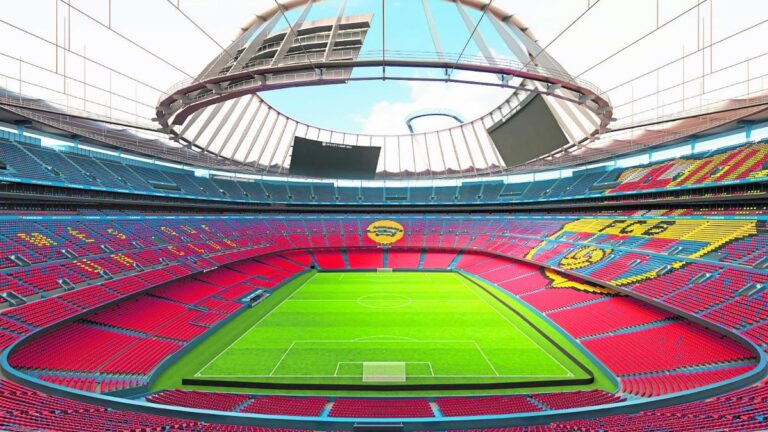
Barcelona will put a decade-defining set of numbers in front of their members on Saturday morning. The Barcelona business plan that the board will talk through at the Ordinary General Assembly sets a target of €1.45 billion in annual revenue before the end of the current mandate in 2031, with a finished Spotify Camp Nou cast as the engine that gets the club there.
According to Mundo Deportivo, that headline figure sits alongside the accounts for the season just gone and the budget for the one under way. The 2025/26 campaign, closed on 30 June, produced turnover of around €1.06 billion and a marginally positive ordinary result — but a final loss of €18 million once extraordinary items and corporation tax were applied.
Barcelona business plan: €1.45bn by 2031, and how they get there
The extraordinary hit came mainly from another write-down of Barca Productions. The club believes that particular wound has now been closed: a fresh valuation has been agreed with the auditor, and Barcelona expect the media arm to start generating a return rather than requiring further impairments.
The 2026/27 budget submitted to the members forecasts €1.195 billion in income against €1.133 billion in costs, with a wage bill of €636 million — 53 per cent of revenue. After the club’s financial result, the Espai Barca line (−€67 million) and consolidation (+€6 million), the projected bottom line is a profit of €1 million. Notably, the budget has been built on the assumption of winning La Liga and reaching the Champions League quarter-finals, which is a fairly bold way to balance a spreadsheet.
Mundo Deportivo describes the projections as deliberately conservative: a €60 million uplift in stadium revenue calculated on a 62,000 capacity rather than the eventual six figures, plus €50 million from Barca Licensing & Merchandising. Per MARCA, the longer-range plan pencils in EBITDA of €370 million for 2030/31, up from €184 million last season.
The stadium is the whole argument
Everything in the plan leans on the same asset. The permitted capacity at the Spotify Camp Nou currently stands at 62,652, and Barcelona expect it to rise to between 70,000 and 72,000 in the early months of 2027 as part of the third tier comes back into use. Some VIP areas could open as soon as next month, the roof installation is scheduled for next summer, and the completed ground is designed for more than 104,000 — the largest in Europe.
That timeline now has a fixed deadline attached to it after UEFA confirmed the Camp Nou as host of the 2029 Champions League final, choosing Barcelona ahead of Wembley. Dynamic pricing in the VIP seats and the reopening of the Tercera Graderia are the two levers the business plan relies on most.
What the members are actually voting on
The Assembly is held telematically from 9:30am on Saturday, with the table constituted in the Auditori 1899 inside the stadium. Compromisaris were given an in-person briefing on Tuesday at the Camp Nou commercial office, led by economic vice-president Ferran Olive and institutional vice-president Elena Fort, where members put their questions directly to the board.
Beyond the accounts, socis will be asked to approve the financing operations tied to Espai Barca — an expansion of the funding already secured and a new bond issue backed by additional audiovisual rights, including the €300 million the club intends to raise for the stadium roof. Also on the agenda are Babylon Park and a residential project in the United Arab Emirates alongside Ohana Development, who will become a new global sponsor and carry their logo on the back of the shirt.
The number that still hangs over it
Not everything in the file reads as smoothly. Reviewing the Crowe audit in Mundo Deportivo, columnist Domenec Garcia notes that negative net equity moved from €153 million to €168 million over the year, when it needed to fall by 10 per cent to avoid a further UEFA sanction — hence the €92 million subordinated loan the club has requested as a mechanism to sidestep the penalty. The same audit flags negative working capital of €404 million and short-term debt rising from €266 million to €534 million.
Set against that, Forbes now values Barcelona at €6.5 billion, a 57 per cent rise on 2021, and the club has cleared the billion-euro revenue mark. Saturday is where those two stories — the asset and the arithmetic — are argued out in front of the people who own the place. It is also the sort of meeting where the salary-cap squeeze the Blaugrana have lived with finally starts to look like a problem with an expiry date, provided the builders keep to schedule.