The Julian Alvarez Manchester City file has been reopened, and it has been reopened at the worst possible moment for Barcelona.
With three days left in the window, the Argentine has ended his stand-off with Atlético Madrid by returning to the training ground alone — and while he was doing it, his old club in England quietly asked the question nobody at the Camp Nou wanted asked.
According to a report relaying MARCA, Alvarez went back to Cerro del Espino on Friday afternoon to work individually with a club fitness coach, drawing a line under the “indisposition” that had kept him away from his team-mates for three consecutive days. And in those same hours, Manchester City entered the picture.
Why a Julian Alvarez Manchester City return is being explored
City’s interest is exploratory rather than concrete. There are no formal negotiations, no bid, and by the account of the report, the first idea on the table was a loan rather than a permanent deal. But the logic behind it is not hard to follow.
City’s attacking department has thinned out. The departures of Omar Marmoush and Savinho left City short of forward options who can play off the shoulder of Erling Haaland or in place of him, and Alvarez — a player they know inside out, who won everything there is to win in a sky blue shirt — has suddenly become available in a way he was not two weeks ago. When a squad has a hole and a former player of that calibre is publicly at war with his employer, somebody at the club is going to pick up the phone. Somebody did.
The irony is heavy. Alvarez left the Etihad in 2024 precisely because he could not accept a supporting role behind Haaland. He wanted to be the centre-forward, not the alternative to one. Two years later, the escape route from a situation that has become intolerable may be a return to the exact circumstances he escaped from.
Why City hit the same wall as Arsenal
Before anyone in Catalonia panics, it is worth being clear about what City are walking into. They face precisely the obstacles that have stopped Arsenal, who have been circling Alvarez for weeks, from making a decisive move.
The first is the player. Alvarez is described as reluctant to go back to England at all. He did not leave the Premier League on bad terms, but he left it for a reason, and that reason has not changed. Barcelona — Hansi Flick’s Barcelona, a side that has scored seven goals in its opening two league fixtures without a recognised No. 9 on the pitch — is where he wants to play. Everyone involved knows it.
The second is the price. Atlético will not open negotiations below €150 million, and the only scenario in which that number moves is one where a top-level replacement arrives as part of the deal. Viktor Gyökeres has been floated as the sort of profile that could change the conversation. For a loan, which is where City reportedly began, the gap between what is being asked and what is being offered is not a gap at all. It is a canyon.
So City are, for now, in the same queue as Arsenal — a queue that leads to a door Atlético have bolted from the inside.
What Atlético are actually saying
The position from the Metropolitano has hardened rather than softened. Chief executive Miguel Ángel Gil Marín reiterated on Thursday that Barcelona is not an option under any circumstances and that Atlético’s intention is to “recover” their striker — to have him back in the squad, playing, this season. That is a considerably more aggressive line than simply refusing to sell.
It also, as Mundo Deportivo director Santi Nolla argued in a column published on Friday evening, sits awkwardly beside everything else Atlético have done. Nolla’s point is straightforward: if the club’s genuine position were that Alvarez is indispensable and is going nowhere, the argument would hold. But that argument stops holding the moment a sale to Arsenal is placed on the table in the same breath. What is left, in his reading, is not a refusal to sell. It is a veto — one club specifically excluded, on grounds nobody has satisfactorily explained.
Nolla goes further, noting that Barcelona spoke to the player’s representatives to establish whether he wanted to come, then made the club a €100 million offer, and asking what exactly is unethical about that. Barcelona have watched Antoine Griezmann, Luis Suárez and David Villa move to Atlético over the years on perfectly civil terms. His conclusion is that fans of both clubs would prefer to believe this is negotiating theatre — firm public postures designed to create leverage before a deal that suits everyone — rather than something more personal. That remains an opinion, not a fact, and Atlético have given no indication it is correct.
Where this leaves Barcelona
Uncomfortably, is the honest answer. Barcelona have the one thing money cannot buy in a transfer negotiation — the player’s preference — and none of the things that actually complete transfers. They cannot force Atlético to the table. They will not be given a price, because a price implies a negotiation, and Atlético have refused to have one.
The club’s own reading of the endgame, as we covered earlier, is that the only mechanism still theoretically available runs through Spanish employment law rather than through a boardroom — a route that is legally real, financially enormous and vanishingly unlikely to be walked in three days. Everything else is waiting.
What City’s arrival does is change the shape of the risk. Until now, the worst realistic outcome for Barcelona was that Alvarez stayed at Atlético, sulked through the autumn and became gettable in January — which is, by most accounts, the plan Flick and Deco have quietly made their peace with. A second Premier League club joining the chase raises the possibility of a bidding situation in the final 72 hours, and a bidding situation is the one environment in which Atlético’s €150m valuation stops being a deterrent and starts being a number somebody might actually pay.
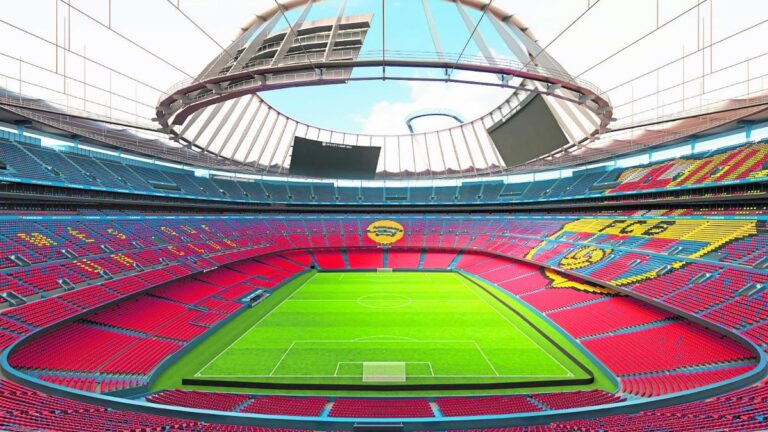
There is a further wrinkle that will not have escaped anyone at the Camp Nou. City are one of the opponents waiting for Barcelona in this season’s Champions League league phase, with the fixture scheduled for the Spotify Camp Nou following Thursday’s draw. Watching Alvarez arrive in Barcelona in a City shirt would be a particular kind of ending to this story.
The deadline maths
The window shuts on 31 August. That leaves Alvarez with a narrow and unappealing set of choices: stay at Atlético and try to rebuild a relationship that has been publicly shredded, accept a move to a Premier League club he has no desire to join, or hold out for a Barcelona transfer that the selling club has promised will never happen.
His return to individual training on Friday reads, on the face of it, as the first of those — an acknowledgement that the standoff has run its course and that pushing harder will only damage him. Atlético had reportedly set Friday as the deadline for him to resolve his position after four days away from the group, counting a session on Tuesday for injured players and World Cup returnees that he also missed.
For Flick, the practical consequence is that the false-nine solution stays. Raphinha scored leading the line against Athletic Club and Fermín López has started the season sharply; Barcelona are not short of goals. They are short of a specialist centre-forward, and unless something extraordinary happens between now and Monday night, they will start this campaign without one.
Barcelona’s offer is still on the table. Atlético are still refusing to look at it. And now Manchester City are in the room too.