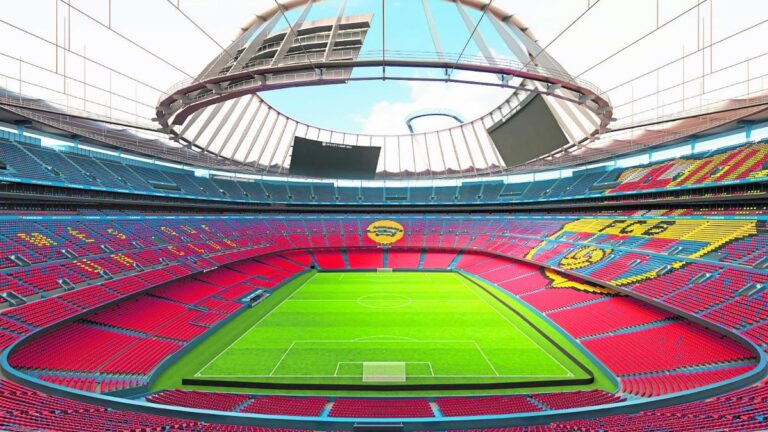
The Spotify Camp Nou is the clear front-runner to stage the 2029 Champions League final. According to Mundo Deportivo, Barcelona’s bid to host European club football’s biggest night on 2 June 2029 currently sits ahead of Wembley in UEFA’s thinking, with the decision due at the Executive Committee meeting in Thessaloniki on Tuesday 15 September.
For a stadium still wrapped in scaffolding, that is a remarkable position to be in — and it says a great deal about how confident UEFA has become in the rebuild.
Why UEFA likes the Spotify Camp Nou bid
The Blaugrana candidacy is not the club acting alone. It carries the formal backing of Barcelona City Council, the Generalitat de Catalunya, the Spanish football federation and the national government — the kind of institutional weight UEFA looks for when it hands out its showpiece.
Then there is the picture itself. When the works are complete, the Spotify Camp Nou will hold 104,600 supporters, making it the largest stadium in Europe. As Mundo Deportivo reports, the prospect of a European final played in front of a full house of that size is close to irresistible for the governing body.
The hospitality numbers matter to UEFA too. The redeveloped ground will expand from 2,500 VIP seats to 9,400, with a double ring of boxes inserted between the second and third tiers. Barcelona’s airport capacity and hotel stock — a genuine problem for some rival host cities — is another point in the bid’s favour.
The building site is not the obstacle it looks
The obvious objection is that nobody has yet seen the finished article. UEFA does not appear to regard that as a problem. Its officials know the project in fine detail, having made repeated visits to the site before granting the green light for Barcelona’s return to Champions League football at the ground in December 2025. The roof is scheduled to be installed next summer, leaving a comfortable margin before a 2029 final.
Put simply, by the time the trophy is being polished, the Spotify Camp Nou will have had years of competitive football behind it. The risk UEFA is being asked to take is far smaller than the headline “unfinished stadium” suggests.
Wembley’s problem is that it keeps winning
The rival bid is a serious one. Wembley is a 90,000-seat venue in a city with unmatched transport links, and it has hosted the final three times since reopening in 2007 — in 2011, 2013 and 2024. The old Wembley staged five more, in 1963, 1968, 1971, 1978 and 1992.
That history is now working against it. UEFA rotates its finals, and London has had a recent turn. There is also a scheduling complication: the year before the 2028-29 Champions League campaign concludes, Wembley is set to host both European Championship semi-finals and the final. Two major continental showpieces in consecutive summers at the same venue is a hard sell.
A stadium with final pedigree
The Camp Nou has done this before, and the two nights it has staged are among the most famous in the competition’s history.
- 1989 — Arrigo Sacchi’s Milan dismantled Steaua Bucharest 4-0.
- 1999 — Sir Alex Ferguson’s Manchester United beat Bayern Munich 2-1 to complete the treble.
Thirty years on from that second night, Barcelona want a third. The symmetry is not lost on anyone at the club.
What it would mean for Barcelona
Hosting a final is a commercial and reputational win in its own right, but the timing is what makes it valuable to the current board. The stadium project has been the defining, and at times painful, undertaking of Joan Laporta’s presidency. A UEFA final awarded to the finished Spotify Camp Nou would be an emphatic external endorsement of the whole exercise.
It is worth being clear about one thing: hosting rights do not come with a place in the match. Barcelona would still have to qualify the hard way, and the 2028-29 season is a long way from a squad that has only just begun its 2026-27 campaign under Hansi Flick. Right now the focus is on a demanding league-phase draw that begins away at Sabah FK in Azerbaijan, and on this season’s final, which is scheduled for the Metropolitano in Madrid on 5 June 2027.
When we will know
The answer arrives on 15 September in Thessaloniki. Should the Executive Committee follow the direction Mundo Deportivo describes, Barcelona will have secured the 2 June 2029 final — and a target date for the rebuilt ground that no amount of construction commentary can match.
Until then, it remains a report rather than a decision. But for a club that has spent three years explaining what the Spotify Camp Nou will eventually be, being named UEFA’s preferred option is the strongest signal yet that the outside world believes it. Follow the rest of our Champions League coverage at ReadBarcelona.