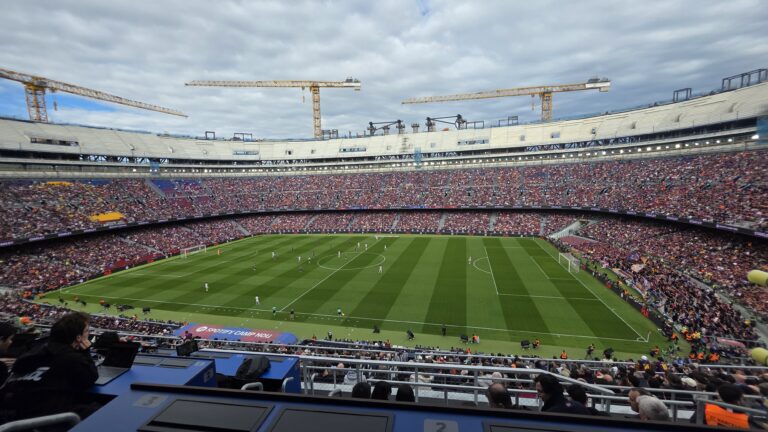
FC Barcelona’s latest victory has once again been overshadowed by the trace of the VAR lines. It should’ve been a moment of redemption for Ferran Torres against Celta Vigo. Instead, however, a key moment transformed into a national debate regarding the fairness of technology in modern football.
This decision isn’t about just a matter of millimeters. It involves the interpretation of a tool that seems to be forgetting the “spirit of the game.”
The Chronology of a “Ghost” Barcelona Goal
Following one of his trademark diagonal runs, managed to find the back of the net after being set up by substitute Roony Bardghj. Any celebration, however, was short-lived. After a review that felt like an eternity for those in the stands, VAR ruled that a fraction of Ferran’s shoulder invalidated the play.
The Technical Key: How Does Semi-Automated Offside Work?
Unlike traditional VAR, where an operator manually drew lines, the current system utilizes:
- 12 specific cameras installed under the stadium roof.
- 29 data points per player, captured 50 times per second.
- A 3D model that determines the exact position of limbs at the moment of ball impact.
However, the controversy regarding Ferran lies in the exact frame chosen. Refereeing experts suggest that the difference between a legal goal and a disallowed one depends on whether the system selects the frame of initial contact with the ball or the frame of release. It’s a fraction of a second that, at top speed, shifts a player’s position by centimetres.
Barcelona Under the “Hawk-Eye” Microscope
This isn’t the first time Hansi Flick’s squad has faced such millimetric rigor. This season, Barcelona have seen goals overturned for offsides that defy human perception (much like the infamous Robert Lewandowski case in San Sebastián).
This opens another debate: the on-field official’s authority is being delegated to a VOR room that prioritizes geometry over the actual advantage gained by attackers. In Ferran’s case, the positional advantage was non-existent, reopening the question of whether VAR should only intervene in cases of “clear and obvious errors.”
Reliability vs. Spectacle
In our effort to report with rigor, we must separate technological reliability from sporting coherence:
- Technologically: The system is precise within its own parameters. If any part of the body is ahead, the software does not lie. The issue is that the frame isn’t always correct, and occasionally, there are glaring errors.
- Sportingly: Attacking football is being penalised. The offside rule was created to prevent a striker from “camping” near the goalkeeper, not to punish a larger shoe size.

FC Barcelona remains the team that lives most dangerously on the touchline in Europe. Flick’s bold tactical approach requires forwards to live on the edge; as long as VAR continues to be applied with this surgical rigidity, Barca must learn to live with the frustration of “invisible goals.”
At least Lamine’s penalty was enough to seal the points in a 1-0 win. Though his hamstring injury is a worry for both the Catalans and Spain.